
Last updated: November 4, 2026
A single mature Monstera deliciosa leaf can grow wider than a dinner plate, and a well-grown specimen can tower past six feet in a living room. That’s not an accident. Large Monstera care comes down to a handful of decisions made consistently over months, not some secret trick. I’ve grown mine from a $15 cutting into a plant that now needs its own corner of the house, and most of what made that happen is boring, repeatable habit.
This guide walks through exactly what large Monstera care looks like in practice: light, water, soil, support, and the mistakes that stall growth before it starts.
Quick Answer
Large Monstera care means giving the plant bright, indirect light, watering only when the top 1-2 inches of soil dries out, keeping humidity above 50%, and providing a sturdy pole or trellis once it starts climbing. Get those four things right and a healthy Monstera deliciosa can realistically reach 6-8 feet indoors within a few years.
Key Takeaways
- Bright, indirect light produces the biggest leaves and the most fenestrations (holes and splits).
- Water only when the top 1-2 inches (about 3-5 cm) of soil feels dry, per Penn State Extension’s Monstera guide.
- Humidity above 50% keeps large leaves lush, especially during winter heating season.
- A moss pole, trellis, or stake is essential once the plant starts producing long internodes.
- Chunky, well-draining soil prevents root rot in big, root-dense containers.
- Monstera deliciosa and Monstera adansonii are different species with different leaf shapes and growth habits.
- Pruning and propagating long stems keeps a large plant manageable without losing size.
- Monstera is toxic if chewed by pets or kids, so placement matters.
How Often Should I Water a Large Monstera?
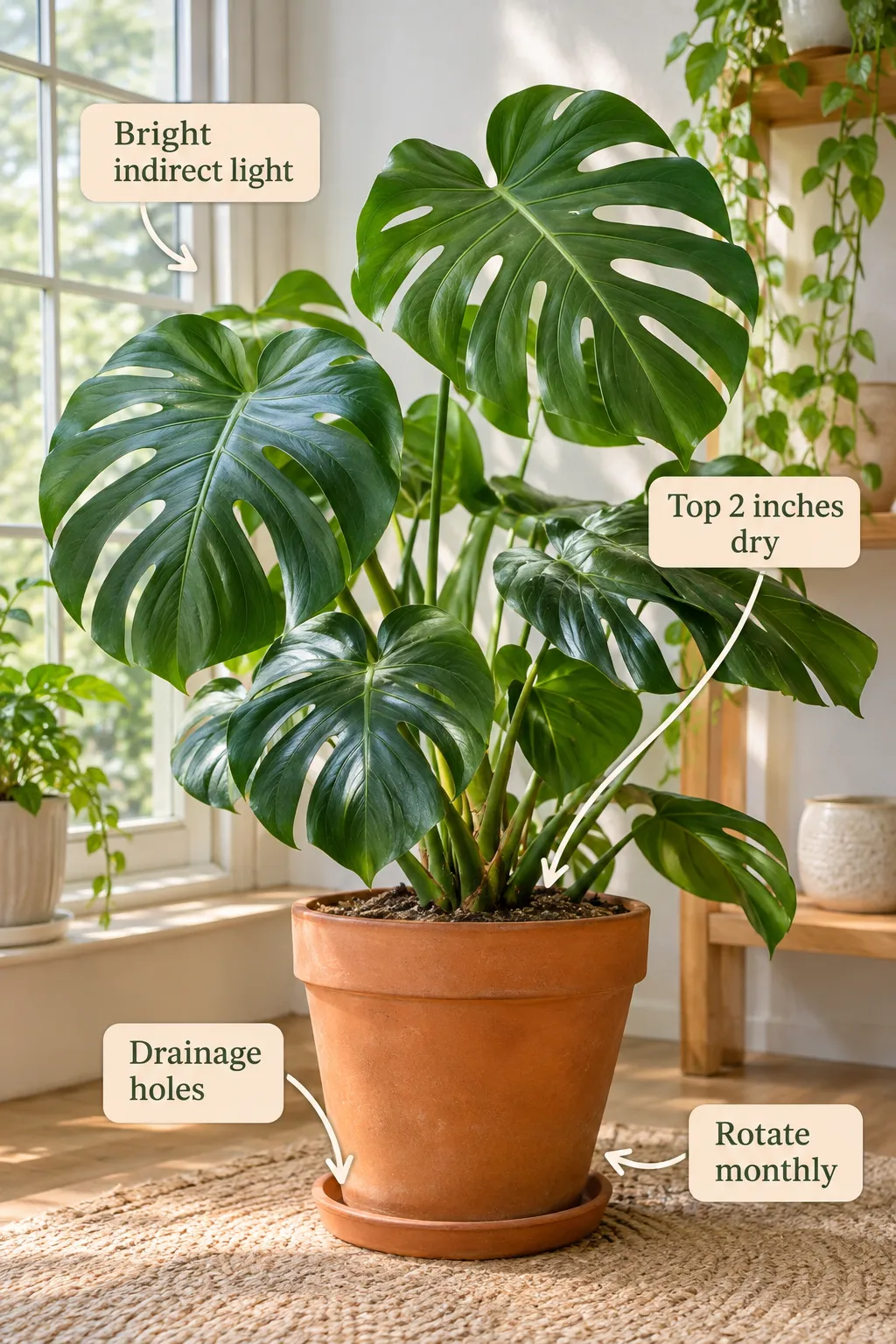
Water a large Monstera when the top 1-2 inches of soil feel dry to the touch, then water thoroughly until excess drains out the bottom. For most indoor homes, that’s roughly every 7-14 days, though it varies by season and pot size.
Big Monsteras in big pots hold more soil, which means they dry out slower than a small starter plant. Check with your finger instead of following a fixed calendar.
- Water thoroughly, letting it run through the drainage holes completely.
- Never let the pot sit in a saucer of standing water.
- Water less in winter when growth slows down.
Common mistake: watering on a strict weekly schedule regardless of how the soil actually feels. Recent extension and care guides consistently flag overwatering as the top cause of decline in mature specimens, since dense root systems trap moisture longer than people expect (Penn State Extension, Costa Farms).
What Kind of Light Does Monstera Need to Grow Big?
Monstera needs bright, indirect light to grow large leaves with signature holes, called fenestrations. Direct afternoon sun will scorch leaves, while deep shade produces a leggy plant with small, solid leaves.
A spot a few feet from an east or south-facing window, filtered by a sheer curtain, works well. Rotate the pot every few weeks so growth doesn’t lean permanently toward the light source.
Decision rule: choose a bright room with filtered light if you want dramatic, split leaves. Choose a dimmer spot only if you’re okay with slower growth and plainer foliage.
Can Monstera Grow in Low Light?
Yes, Monstera can survive in low light, but it won’t thrive there. It will grow slowly, produce smaller leaves, and likely skip the characteristic splits and holes that make it a “statement plant” in the first place, according to recent plant care coverage (BHG Australia).
If bright light isn’t an option, Monstera will still live, just don’t expect it to size up quickly. For other species that genuinely tolerate dim corners, our guide to houseplants for low light that survive neglect is a better fit.
How Much Space Do You Need for a Monstera Indoors?
A mature indoor Monstera needs at least a 3-4 foot radius of open floor and ceiling clearance, since mature plants can reach 6-8 feet tall with leaves spanning 1-2 feet wide. Cramped corners stunt growth and cause leaves to flatten against walls or furniture.
Give it room to spread, and plan for a pole or trellis that adds another foot or two of vertical reach. A tall planter in an empty corner can be the perfect staging spot for a plant this size.
How Big Can Monstera Get Indoors?
Indoors, a well-cared-for Monstera deliciosa typically reaches 6-8 feet tall over several years, with individual leaves eventually spanning a foot or more across. Outdoors in tropical climates it can climb much taller, but indoor growth is naturally capped by pot size, light, and support.
Growth speed depends heavily on light and consistent care, not luck. Expect one or two new leaves per month during active spring and summer growth under good conditions.
Why Are the Leaves on My Monstera Turning Yellow?
Yellow leaves on a Monstera are almost always a sign of overwatering, though they can occasionally mean the plant needs more light or more fertilizer. Check the soil first before assuming the worst.
- Soggy soil + yellowing: cut back watering and check for root rot.
- One old lower leaf yellowing occasionally: normal aging, nothing to worry about.
- Yellowing plus pale new growth: may need feeding during active growing months.
If you’re also dealing with yellowing on other houseplants this season, our pothos winter care checklist covers very similar troubleshooting logic.
Why Are Brown Spots Appearing on My Monstera Leaves?
Brown spots usually mean inconsistent watering, too much direct sun, or low humidity causing crispy edges. Bacterial or fungal spots tend to look wet and yellow-ringed, while sun scorch looks dry and papery.
- Move the plant out of direct sun if spots appear on the sun-facing side.
- Increase humidity if edges are crisping and curling.
- Isolate the plant and trim affected leaves if spots look wet or spreading fast.
What Soil Should I Use for Monstera?
Monstera needs a chunky, well-draining potting mix, not dense standard potting soil. A blend of regular potting mix with perlite, orchid bark, and some coco coir mimics the loose, airy conditions this aroid prefers in the wild.
Horticultural guides consistently point to waterlogged, compacted soil as a leading cause of root rot in large, mature specimens with dense root mass (Deep Green Permaculture). Always use a pot with drainage holes, no exceptions for big plants.
How Do You Stake or Support a Large Monstera Plant?
Use a moss pole, coir totem, or sturdy wooden stake to support a large Monstera as it grows, since it’s naturally a climbing plant. Without support, heavy stems and large leaves will flop, and aerial roots won’t find anything to grip.

- Insert the pole close to the main stem while repotting, if possible.
- Loosely tie the stem to the pole with soft plant ties.
- Gently guide aerial roots toward the pole instead of letting them dangle.
- Add new ties every few inches as the plant climbs higher.
University extension resources note that Monstera deliciosa is a natural climber and does best indoors when given this kind of vertical structure (University of Minnesota Extension).
What’s the Difference Between Monstera Deliciosa and Adansonii?
Monstera deliciosa has large, thick leaves with deep splits and oval holes, while Monstera adansonii has smaller, thinner leaves with more oval-shaped holes and a trailing or climbing vine habit. Deliciosa is the classic “statement plant,” while adansonii is better suited to hanging baskets.

Choose deliciosa if you want a big architectural floor plant. Choose adansonii if you want a smaller, bushier vine for a shelf or hanging planter.
Is Monstera a Good Plant for Beginners?
Yes, Monstera is a solid beginner plant because it tolerates a range of light conditions and forgives occasional missed waterings. It’s not foolproof, though, and new owners most often go wrong with overwatering rather than underwatering.
If you’re newer to houseplants in general, our broader guide for beginners who always kill their plants is a useful companion read alongside this one.
What Are Common Mistakes People Make with Monstera Care?
The most common Monstera mistakes are overwatering, placing it in direct sun, skipping support structures, and ignoring dust buildup on leaves. Each one quietly stalls growth without an obvious, immediate cause.
- Watering on a schedule instead of checking the soil.
- Keeping it in a dim corner and expecting dramatic fenestrations.
- Letting dust coat large leaves, which blocks light absorption and invites pests.
- Skipping a pole until the plant is already leaning or top-heavy.
Wipe large leaves regularly with a soft, damp cloth, both for appearance and plant health, as recent care columns consistently recommend for big-leafed specimens (Flora Grubb Gardens).
How Much Does a Large Mature Monstera Cost?
Prices for extra-large Monstera plants vary widely depending on size, pot, and local availability, often ranging from modest for a medium plant to significantly more for a tree-sized specimen with multiple stems. Specialty nurseries and big-box retailers, including IKEA’s potted Monstera deliciosa, sell varying sizes at different price points, so shopping around pays off.
Buying smaller and growing it yourself is almost always cheaper than buying an already-large specimen.
Can You Propagate Monstera to Grow a Bigger Plant Faster?
Yes, propagating Monstera cuttings is a common way to multiply your collection, but it grows a new, separate plant rather than making your existing one bigger. To make your current plant fuller, prune leggy stems back to a node instead.
University extension guidance recommends taking cuttings with at least one node and a healthy aerial root, then rooting them in water or moist sphagnum moss before potting up (University of Minnesota Extension).

A quick note on browsing for Monstera deals online: if a retailer’s page shows a message like “google anfrage wird verifiziert, kannst wenigen sekunden fortfahren, aktualisiere diese seite” while loading a product listing, that’s just an automated bot check confirming you’re not a script, and in a few seconds it clears on its own. Fortfahren is usually automatic, and you typically don’t need to click weiter or do anything else; if the page does not refresh, aktualisiere the page manually and continue shopping.
Current coverage frames 2025 and 2026 as peak years for Monstera’s popularity as an indoor statement plant, with multiple features calling it one of the most iconic houseplants worldwide (The News Herald). That popularity means more sizes and price points at nurseries than ever before, which makes starting small and growing your own large specimen an even more appealing route.
FAQ
What to do with a huge Monstera plant?
Give it a sturdy pole or trellis for support, prune any leggy or bare stems back to a node, and consider propagating the cuttings into new plants. Repot into a slightly larger container only when roots are visibly crowded, not on a fixed schedule.
How to tell the back of Monstera?
The back of a Monstera leaf is paler green, has a slightly rougher texture, and shows the raised veins more clearly than the glossy front side. The front faces toward the light source and develops the characteristic glossy sheen over time.
Do monsteras prefer deep or wide pots?
Monsteras generally do better in pots that are proportionate to their root ball rather than extremely deep or extremely wide, since overly large pots hold excess moisture and raise root rot risk. A pot just 1-2 inches wider than the current one, with good drainage, is the safer choice.
How to take care of Monstera deliciosa plant?
Give Monstera deliciosa bright, indirect light, water when the top 1-2 inches of soil dries out, keep humidity above 50%, and provide a pole for climbing support. Use well-draining, chunky soil and wipe leaves occasionally to remove dust.
Conclusion
Large Monstera care isn’t complicated, it’s consistent. Bright indirect light, soil that’s allowed to partly dry, decent humidity, and a sturdy pole will take a small cutting to a genuine statement plant over a couple of seasons. Watch the soil, not the calendar, and don’t skip the support structure once it starts to climb.
If you’re building out a full indoor plant lineup this season, browse more growing guides in our houseplants and indoor growing hub for ideas beyond Monstera.


One comment on “Large Monstera Care: How to Grow a Big, Healthy Statement Plant Indoors”